 I’m posting on the subject of our callings. In the last two posts I talked about how the Lord calls us by name.
While they were worshiping the Lord and fasting, the Holy Spirit said, “Set apart for me Barnabas and Saul for the work to which I have called them.”
Acts 13:2
The next calling is a calling of work. We’re called to do something. Christ has prepared a work for each of us to do in His kingdom.
This is the calling that seems to be the most important to believers today. Much emphasis is placed upon people to find what God wants them to do. The problem is that many never seek God to find out how He wants them to fulfill their work. Instead they try to copy another person or ministry.
“I will destine you for the sword, and you will all bend down for the slaughter; for I called but you did not answer, I spoke but you did not listen. You did evil in my sight and chose what displeases me.”
Therefore this is what the Sovereign LORD says: “My servants will eat, but you will go hungry; my servants will drink, but you will go thirsty; my servants will rejoice, but you will be put to shame. My servants will sing out of the joy of their hearts, but you will cry out from anguish of heart and wail in brokenness of spirit.”
Isaiah 65:12-14
When we try to fulfill the what of our ministry in our own way, we ignore the call of God to do it His way. When that occurs, we don’t have any supernatural provision for what we’re doing. Everything God has for you is tied to your calling.
If you don’t respond to His call, both the what and the how, you lose out on the grace that has been provided for you. This is a cause of great frustration in ministry; because you think you’re doing God’s will when, in reality, you’re only halfway there.
There are many believers in ministries today who are spiritually hungry and thirsty. They’re being put to shame and crying out of anguish of heart. This isn’t God’s portion for us. He wants ministry to be a joy. This will only happen as we follow God’s call. This means not only what He wants me to do, but also how He wants me to do it.
Nevertheless, I have this against you: You tolerate that woman Jezebel, who calls herself a prophetess. By her teaching she misleads my servants into sexual immorality and the eating of food sacrificed to idols.
Revelation 2:20
Another mistake that can totally disqualify you is to seek your own will altogether. The above Scripture says that she called herself a prophetess. It doesn’t matter what you want to call yourself. The important thing is to find out what God calls you. Only then can you enter the abundance of God’s supernatural provision. Taking His road for your life is the only path that will lead you to the level of excellence that God has reserved for you.
Please realize, the how is as important as the what in serving God. That’s why preparation for ministry is so important. It’s not enough just to go to Bible School to train. The “School of the Holy Spirit” – spending quality time in the presence of the Lord – is essential to the fulfilling of the total plan of excellence God has for your life.
Question: What is the work God is calling you to do?
© Nick Zaccardi 2015
Tags: calling, calling of God, Holy Spirit, joy, ministry, preparation, provision, work
 We talk a lot about the grace of God. As believers we’re always praying for grace. Many seem to be always running around seeking God’s grace. Why is that? How we answer that question is very important.
Why do you want the grace of God in your life? Is it another way of saying, “I want God’s blessing on my life.”?
I’ve heard grace defined in many different ways. God’s unmerited favor. The enabling power and presence of God. All we need for life and godliness. They’re all good descriptions, but they leave out a key ingredient – purpose.
There’s always a reason attached to the grace of God. Listen to how the Apostle Paul explains it.
Through him and for his name’s sake, we received grace and apostleship to call people from among all the Gentiles to the obedience that comes from faith.
Romans 1:5
In this short verse I see three elements of grace. They speak not only about what God wants to bless us with, but how He wants us to use what He freely gives us. We need to take these to heart as we seek to manifest God’s grace.
Through Him and for His Name’s Sake – He doesn’t give us His grace so that we can spend it on our pleasures. It’s about His agenda on the earth. What does the Lord want to accomplish through me? That’s where His grace comes to the forefront.
I need to pick up this attitude. I receive His grace so that His name will be magnified in my life.
We Received Grace and Apostleship – Grace and calling go hand in hand. Seeking God’s grace without finding your calling in Christ is worthless. It’s through His grace that you fulfill your purpose.
It’s the Lord’s grace that brings you into your destiny – what you were created for. Without that knowledge, you’re simply living from problem to problem. Instead of always seeking grace to get over the next obstacle, find the direction that the Holy Spirit is leading you to.
To Call People from among All the Gentiles – Paul was aware that God’s grace had pinpoint accuracy. He was called to bring the Gospel of Christ to the Gentiles. That’s why God poured His grace on Paul’s ministry.
It’s the same for us. As we grow in Christ, we need to fine tune our calling. Who am I called to reach? What are my gifts and abilities? As you begin to answer these questions, you find that perfect position of grace that you’re called to walk in.
Be careful to always heed Paul’s warning…
As God’s fellow workers we urge you not to receive God’s grace in vain.
2 Corinthians 6:1
That means that I don’t receive the grace of God for no purpose. Grace is always attached to destiny. Our walk today must be with an eternal focus. That’s what the Lord’s grace is all about.
Question: How have you seen the grace of God active in your life and ministry?
© Nick Zaccardi 2014
Tags: blessing, calling, destiny, elements of grace, favor, grace, grace and destiny, power, praying, presence, purpose, seeking
 I’ve been posting about going to God for the needs of others.
Do you remember, in Scripture, when Jesus was approached by a Canaanite woman on behalf of her daughter? She asked for healing and the Lord seemed to give her a hard time. He even went as far as calling her a dog – the Hebrew term for a Gentile.
He didn’t do this to be mean, but to prove a point to His disciples. He wanted them to see how great her faith was regarding Christ.
Because she pressed in, her daughter ended up being healed. Look at the exchange between Christ and the woman.
He replied, “It is not right to take the children’s bread and toss it to their dogs.”
“Yes, Lord,” she said, “but even the dogs eat the crumbs that fall from their masters’ table.”
Then Jesus answered, “Woman, you have great faith! Your request is granted.” And her daughter was healed from that very hour.
Matthew 15:26-28
There are some very important truths contained in this passage. First note that Jesus called healing the children’s bread. It’s right for the children to eat. God does not view healing as a privilege, but a necessity. I talk about healing in another series of posts.
What I want you to see at this point is that when Jesus walked the earth, Israel had an “all about us” attitude concerning the blessings of God. They were very selfish concerning the Word and the promises of God.
This is interesting since they wasted most of what they received. They rejected the ministry of Christ even though He was trying to lift them up to a greater walk with God.
It’s a principle we see played out over and over again. The simple fact is that children are very selfish with their food. I see it all the time.
Because of this, whenever we have a church dinner, we tell parents of small children to accompany them to the food table. Without parental control, a child will load his plate up with the food he likes without thought to whether there’s enough for others, or even if he’s able to finish it all. He just wants to see it all on his plate.
Many times we’re the same way in our walk with the Lord. We’re very selfish concerning the Word of God. We want every blessing of Scripture to be all about us. Then we’re like selfish children who play with their food and end up wasting most of it.
In the above passage, the world is illustrated as dogs that are hungry, and circling the table where the children are eating. They’re desperate. They’re coming from a place where there’s a famine of the Word of God. Even the crumbs of what we have will be satisfying to them.
It’s time for us to stop looking at everything as revolving around our own needs and wants. We must begin to see that our ministry is to those around us. We must start to receive the Word of God as mature saints.
Then be ready to minister this grace to the hungry world.
Question: What spiritual gifts do you possess that could help those around you?
© Nick Zaccardi 2014
Tags: blessings, Christ, healing, Jesus, messy eater, ministry, needs of others, pray, prayer, promises, promises of God, selfish
 I’ve been posting about how we go to God for the needs of others. Let’s continue looking at the parable in Luke, chapter 11.
“I tell you, though he will not get up and give him the bread because he is his friend, yet because of the man’s boldness he will get up and give him as much as he needs.
“So I say to you: Ask and it will be given to you; seek and you will find; knock and the door will be opened to you. For everyone who asks receives; he who seeks finds; and to him who knocks, the door will be opened.
Luke 11:8-10
Listen carefully to the reasoning as to why the man was given bread. It was NOT because of friendship or need. It was because of boldness. It was because the friend was willing to go to the neighbor’s house in the dead of night and pound on his door.
Other people who lived around started to wake up when they heard the commotion. They looked out their windows to see how this man would respond. It was only when it became a matter of his reputation in the community, that this man responded by supplying bread.
Our God is not going to be pressured because you’re begging Him for provision. You can’t gain His sympathy by magnifying the need. These things don’t affect God.
What He’s looking for is someone who’s willing to publicly declare the Word of God before men. He’s looking for boldness.
The important part is found in verses 9 and 10. This is the section that tells us that if we ask, it will be given, if we seek, we will find, and if we knock, the door will be opened. Our normal thoughts are that this is all about me getting what I want from God.
In this context, Christ is speaking about going before God on behalf of the needs of others. It’s about meeting the needs of those around us. People we meet everyday – at our jobs, in our schools, and in the stores.
They all have problems they’re facing each day. Most of them have no access to God except through us. We must throw out this idea that the blessings of God are only for me and a chosen few. It’s God’s desire to bless the world through His people.
You don’t have to convince me that God wants to bless believers; that’s beyond question. What I want to open our eyes to is the world around us that’s in need. They need a Savior, a Healer and a Provider. All of these things are found in Christ.
It’s up to us to take this message to the world. Not just by saying, “God loves you.” But by actually bringing the power of Christ into the lives of the hurting people around us.
Take the time to go before the throne room of God with the needs of others. Trust God to perform miracles in those you pray for. If you hear a Word from God for them, then act on it.
We must be God’s hands extended to the world.
Question: What are the specific needs you know about the people around you?
© Nick Zaccardi 2014
Tags: access to God, ask, asking for others, blessing, boldness, Christ, healer, Jesus, knock, knocking for others, provider, provision, savior, seek, seeking for others, supply, word of God
 In my last post I started talking about a parable of Jesus found in Luke, chapter 11. In the Lord’s teaching, a man is looking for bread from his neighbor at midnight.
This parable is about going to God on behalf of the needs of others. Let’s compare this neighbor to what we know about God.
“Then the one inside answers, ‘Don’t bother me. The door is already locked, and my children are with me in bed. I can’t get up and give you anything.’”
Luke 11:7
The first thing this neighbor says is, “Don’t bother me.” The word bother comes from a root word that means to cut. We know from the Scripture, that Jesus Christ was cut and bruised for me.
He bore my sicknesses and diseases. He took upon Himself everything that would hurt or harm me. This neighbor may not want to help, but the God I serve is ready, willing, and able to meet the needs of those I’m praying for.
The next thing he said was, “The door is shut and locked.” How does this compare to what Christ has done for us?
I know your deeds. See, I have placed before you an open door that no one can shut. I know that you have little strength, yet you have kept my word and have not denied my name.
Revelation 3:8
The Lord is the One who opens the door before us. I know that I can go forward boldly because of His work in my life. If I seek God’s path, then I’m assured that the door stands open before me.
No matter what the circumstances look like in the natural, my advancement does not rely upon the hand of man, but on the power of God.
The neighbor also declared, “My children are with me in bed.” Of course, this is how many Christians would like to picture their relationship with God. We want to be cozy in our room – “us four and no more.”
This is not a picture of the God we serve. Christ has clearly commanded us to go into all the world and preach the Good News to everyone who would listen. God wants us to be a blessing to those around us. We are to be salt and light in this dark generation.
The neighbor’s last statement was probably the most important of all, when looking at the comparison with Christ. The man said, “I have no power to rise and give you anything.”
Jesus Christ proved that He was the One with power enough to do all of God’s will.
“The reason my Father loves me is that I lay down my life– only to take it up again. No one takes it from me, but I lay it down of my own accord. I have authority to lay it down and authority to take it up again. This command I received from my Father.”
John 10:17-18
All power in Heaven and earth was committed to Christ. He had the power, not only to lay down His life, but to then rise from the dead three days later. He has proven Himself victorious over sin and the grave.
Unlike this neighbor, Christ has everything I need to be an abundant blessing to those around me if I will go to Him for supply.
Question: What are the needs of others that you are currently seeking God for?
© Nick Zaccardi 2014
Tags: be a blessing, blessing, Christ, God is our supply, Jesus, neighbor, open door, other's needs, pray, prayer, provision, source, supply
 In my last post I talked about the Word of God as bread. I want to continue that discussion by looking at a parable that few ever teach about. We need to see how the bread of the Word applies to our daily lives.
Then he said to them, “Suppose one of you has a friend, and he goes to him at midnight and says, ‘Friend, lend me three loaves of bread, because a friend of mine on a journey has come to me, and I have nothing to set before him.’
“Then the one inside answers, ‘Don’t bother me. The door is already locked, and my children are with me in bed. I can’t get up and give you anything.’
I tell you, though he will not get up and give him the bread because he is his friend, yet because of the man’s boldness he will get up and give him as much as he needs.”
Luke 11:5-8
This parable brings to light an incredible truth. Listen carefully to what the man is asking for. He’s seeking bread. But the important fact is the reason he wants it.
Is he hungry? Does he have no money to buy bread? Absolutely not! These are not the reason he needs bread so desperately.
According to the man, a friend of his was on a journey and has come near to him. He opened his home to the friend but has no bread to place before the friend.
According to Scripture, every human is on a journey. We are all traveling from total spiritual darkness to maturity in Christ. We are all at different places along this path.
What this man was saying is, “My friend’s path brought him into my sphere of influence. I need to help him become what God wants him to be.”
The man was not seeking the bread of the Word for himself. He was seeking a Word that would meet the need of someone else. This is something the church needs to hear. It seems that much of the time we are self-absorbed.
We are always seeking things for ourselves. We seem to think it’s all about my healing, my prosperity, and my blessing. We need to follow the example of Christ. Most of what He sought the Father for was bread that He could give to others.
Notice the humility. My friend has come to me and I have nothing of my own that could meet his need. This is an admittance of our total dependency on God.
I’m trusting God to meet someone else’s need. But I want Him to send the supply through me. This requires us to admit our inability apart from the work of the Holy Spirit in us.
When you spend time in the presence of the Lord, remember to think of others. Listen for a Word that could be a help to them as well as yourself.
Question: How have you helped others along their road to maturity in Christ?
© Nick Zaccardi 2014
Tags: bread of life, daily life, don't be selfish with the bread of life, God's word, others, parable, self-absorbed, supply, word of God
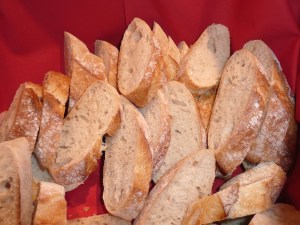 Under the Old Testament law, many different types of offerings were to be presented to God. Some were called Fellowship Offerings because they were given simply out of love for God. An offering of thanksgiving was one of these Fellowship Offerings.
If he offers it as an expression of thankfulness, then along with this thank offering he is to offer cakes of bread made without yeast and mixed with oil, wafers made without yeast and spread with oil, and cakes of fine flour well-kneaded and mixed with oil. Along with his fellowship offering of thanksgiving he is to present an offering with cakes of bread made with yeast.
Leviticus 7:12-13
There are four different kinds of bread that were associated with this offering. The common elements in all of them are flour and oil. I believe that they correspond to the word and the spirit. This is central to thanksgiving since everything I receive from God is through the Word and by His Spirit.
The first bread is cakes of bread without yeast and mixed with oil. The term “unleavened” comes from a root which means to greedily devour because it is sweet. It was made with flour mixed with oil. To make these today, we would use shortening or butter. They would be more like shortbread or butter cookies.
Sometimes the word is sweet to me. I devour it greedily. It satisfies my inner longing and refreshes my spirit. I’m thankful for the Word of God that lifts me up.
The next bread is the wafer – literally, a matzah. This matzah cracker was to be anointed with oil. The matzah is very dry and pierced at regular intervals throughout the cracker.
Sometimes the Word pierces me, like a sword. It’s in times like this that God is doing surgery on me. The Bible teaches that faithful are the wounds of a friend. I need it because this is the place of the anointing. I’m thankful for the Word of God that corrects me.
Another bread is made with fine flour and cooked in oil. Fine flour is like our bakery flour. When we cook something in oil, we call it deep fried – like fried dough or donuts.
This one is brought about in the heat of the spirit. It takes the fire of the Holy Spirit, heating up the Word to produce change in my life. A prophet said to God that Your Word is like a fire in my bones. This fire pushes you to action. Christ has said that He wants you either cold or hot. Lukewarm just won’t cut it. I’m thankful for the Word of God that fires me up to action for the Lord.
The last bread of the thanksgiving offering is made with yeast. Yeast usually speaks of our imperfections. It amazes me that God will entrust His divine Word to imperfect humans. The Lord gives me a word to share with others. If I were God…it would never happen.
But He knows best. He gives us a word to share, even in our humanity. This is something that my imperfect life can give to others. I’m thankful that Christ lets us represent Him by His Spirit.
Thank God.
Question: What are you thankful to God for at this moment?
© Nick Zaccardi 2013
Tags: bread, fellowship offering, fire, flour, Holy Spirit, oil, share, spirit, sweet, sword, thank, thank God, thankful, thanksgiving, thanksgiving bread, thanksgiving offering, word
 This is the final post about how Abraham positioned himself to receive God’s supernatural provision. At this point we find him with the knife raised, about to sacrifice his only son.
But the angel of the LORD called out to him from heaven, “Abraham! Abraham!”
“Here I am,” he replied.
“Do not lay a hand on the boy,” he said. “Do not do anything to him. Now I know that you fear God, because you have not withheld from me your son, your only son.”
Genesis 22:11-12
Abraham was able to come through this time of testing victoriously. But there was something that always puzzled me. God said, “Now I know that you fear God.” I thought God knew everything, so why would He say that?
The Hebrew word for know is Yada, which means to know by seeing. What God said was that now Abraham’s faith could be seen. His fear of God was now obvious to everyone.
That’s the reason for trials and testing. We may have faith quietly tucked away in our hearts. Without works, it’s not yet a living faith. It must be proved genuine.
It’s the trying of our faith that causes it to be seen by those around us. That’s why Scripture tells us over and over again that without trials we’ll never become mature in Christ.
It was when his faith was tested, and proved genuine, that Abraham’s eyes were opened to the provision of God that was before him.
Abraham looked up and there in a thicket he saw a ram caught by its horns. He went over and took the ram and sacrificed it as a burnt offering instead of his son. So Abraham called that place The LORD Will Provide. [Jehovah Jireh] And to this day it is said, “On the mountain of the LORD it will be provided.”
Genesis 22:13-14
Jehovah Jireh – the God Who provides. There are many who think this name is a promise of unbridled wealth. They think that it’s all about their physical comfort. What they fail to see is that Jehovah Jireh is a place of supernatural provision in Christ.
As I said in the first post of this series, it’s a spiritual mountain that must be climbed. To get to that place in God, it will require the same thing from us that it did of Abraham.
It will take a life of immediate obedience to God, perseverance, speaking our faith, and a decision to give up everything for the cause of Christ. That’s the real mountain that Abraham had to climb. The physical mountain was easy in comparison.
As with all things in Christ, God has already provided everything we need for life and godliness. The problem is that we need to position ourselves to receive the provision of God.
That’s the point. Why do we want God’s blessing? To accomplish His will or ours?
If you want Christ to be exalted in you, then you’re in a position to receive.
I ask everyone who reads this post to pray and believe God for those who respond to the following question…
Question: What is God calling you to do that you need His supernatural provision for?
© Nick Zaccardi 2013
Tags: Abraham, Christ, decision, faith, faith that can be seen, fear God, genuine, God who provides, Jehovah Jireh, Jesus, living faith, mountain, obedience, perseverance, position, position ourselves, provision of God, receive from God, speaking, supernatural, testing, trials, trying of our faith, victorious, victory
 We’ve been looking at Abraham’s example of what it takes to be in position to receive God’s blessing. The big question remains. How far are we willing to walk with God down this road of faith that He chooses for us?
When they reached the place God had told him about, Abraham built an altar there and arranged the wood on it. He bound his son Isaac and laid him on the altar, on top of the wood. Then he reached out his hand and took the knife to slay his son.
Genesis 22:9-10
In this remote setting it would have been very easy for Abraham to have chosen differently. He could have taken Isaac with him, and left the area. Yet, he made the choice to follow God’s instructions no matter how painful they were to him.
It’s easy for us to look back and say, “Of course he trusted God.” We have the completed Bible to refer to. We have a knowledge of how the story ended. We know now that God never asks for human sacrifice.
There’s no way that we could ever fathom what it was like to be Abraham at that moment. All he knew was that he was about to take the life of the most precious person in the world to him.
When I see how far Abraham trusted God, it begs the question, how far am I willing to let my faith take me? How much am I willing to give up based solely upon God’s Word?
I think that this generation of believers are more like the rich young man who came to Jesus. The Lord told him to give up everything and come and follow Him.
When the young man heard this, he went away sad, because he had great wealth.
Matthew 19:22
In our society, this call is commonplace. Athletes are told to “leave it all out on the field.” In entertainment competitions they are told to hold nothing back.
Why do we get the idea that Christ is asking too much of us by saying that we must lay our lives down to follow Him? It’s only when I come to the place of total surrender at the feet of the Lord that I’m in the position to receive the strength and blessing that comes from His hand. Jesus held nothing back for our sakes, and now we must follow in His footsteps.
This may not sound like your typical “Six Steps to Prosperity” message. It wasn’t meant to. I’m not looking for the wealth it takes to fulfill my every whim. I want to see the provision I need to fulfill God’s destiny in me. I want to see and experience revival in God’s people.
It’s time for us to lay everything down before the Lord. If you can’t do this, then pray for the strength it takes to get to this point. Then watch what God will do on your behalf.
Question: What things would be the hardest for you to give up if the Lord asked you to?
© Nick Zaccardi 2013
Tags: Abraham, choices, faith, follow Christ, follow God, God, God's blessing, God's destiny, God's word, hold nothing back, how far can you trust God, Isaac, lay down our lives, leave it all on the field, provision, revival, rich young ruler, road of faith, total surrender, trust, willing, willing to give up
 I’ve been talking about Abraham’s example to us in receiving God’s blessing and provision. In my last post I said that we needed to speak what we believe from our heart. This is important because it’s usually our speaking that gets us in the most trouble.
Listen to the exchange that took place as Abraham was taking Isaac up the mountain. All Abraham knew at this point was that God was asking him to offer Isaac up as a sacrifice.
Isaac spoke up and said to his father Abraham, “Father?”
“Yes, my son?” Abraham replied.
“The fire and wood are here,” Isaac said, “but where is the lamb for the burnt offering?”
Abraham answered, “God himself will provide the lamb for the burnt offering, my son.” And the two of them went on together.
Genesis 22:7-8
I can only imagine how much pain this question caused Abraham. I believe that there was a long pause while Abraham thought about how he could answer the boy. It amazes me how simply the answer was formed.
In spite of his confusion, and without anger or bitterness toward God, he spoke the truth in faith and love. This is a lesson we need to take to heart.
So many times we speak without thinking. We especially run into trouble when we talk from the hurt and anguish we’re experiencing. We say many things that we wish we could take back.
That’s why one of the secrets to positioning ourselves to receive God’s blessing is to watch what we say when we’re hurting. James understood this truth.
Likewise the tongue is a small part of the body, but it makes great boasts. Consider what a great forest is set on fire by a small spark. The tongue also is a fire, a world of evil among the parts of the body. It corrupts the whole person, sets the whole course of his life on fire, and is itself set on fire by hell.
James 3:5-6
James is looking at this from a negative perspective. Controlled by the spirit, the tongue can set your life on course for God’s blessing. Controlling the tongue is one of the hardest things we’re called to do, yet it’s one of the most important. What we say can set the emotional foundation for our eventual success or failure.
How we speak, especially in times of confusion and pain, will have a lasting effect on both us and those around us. Is what you’re saying building up or tearing down God’s work?
We must choose to keep a watch over our tongues. If needed, we can go to the Lord in repentance for things that may have been said in hurt or anger. We can ask for His strength to take control of this unruly member of our body.
If we will spend time in the Lord’s presence and meditate upon His Word, then there will be a greater chance that truth and love will come out during stressful times.
Question: When have your words either helped or hurt the situation you were in?
© Nick Zaccardi 2013
Tags: Abraham, anger, believe, bitterness, building up, controlled by the spirit, faith, God, God's blessing, God's work, is your tongue your problem, Isaac, mouth, pain, position, provision, receiving, sacrifice, speaking without thinking, tearing down, tongue, words
 I’m posting on the subject of our callings. In the last two posts I talked about how the Lord calls us by name.









 The Spirit and the Word